For More Humane Prisons
One person alone cannot make a difference. Of course, we can accomplish great things individually, but we have a greater impact when we work together. It’s also an opportunity to learn from other perspectives and try new approaches. That’s why I was so happy when “Radi Vidi Pats” received an email from our Lithuanian colleagues at the association “Prirasytos rankos” (Inscribed Hands), which also works in prisons. Last fall, we hosted our Lithuanian and Swedish colleagues to share our experiences. A few months later, we visited the Sweden. And this month, we had the opportunity to travel to Vilnius and learn about their activities both inside and outside the prison. There were two of us representing Latvia—me, Linda, who has been volunteering at the Liepaja Prison for 8 years. And, since we really enjoy cooperating, I invited Kristians from the Resocialization Department of the Jelgava Prison to join us.
“Prirasytos rankos” essentially does what the Latvian Prison Administration does—it organizes a volunteer movement across the country. They have about 80 active volunteers, but several hundred volunteers have completed training and worked in prisons! Given the work involved in recruiting, engaging, and maintaining motivation among volunteers, this is truly an impressive number.
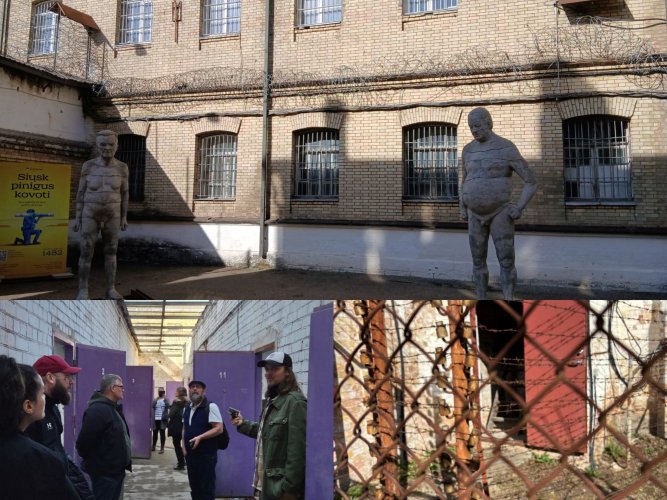
Interestingly, the association’s office is located in the former Lukiskes Prison building. This massive prison ceased operations in 2019, and soon after, artists began working there; bars, recording studios, and rehearsal spaces popped up, concerts started taking place, and artist residencies were established. The massive building complex is also a goldmine for the film industry—several movies have been filmed there, including the fifth season of “Stranger Things.” And in the corridors of the former prison, you can also find the names of various associations. Our visit began with a guided tour of Lukiskes Prison; we learned not only about the prison’s history, which vividly reflects Lithuania’s history over the past 100 years, but also about the changes that have taken place in Lithuania’s prison system.
The visit to the actual Vilnius prison was also a very valuable experience. There, we met with prison staff and inmates, who told us that they greatly appreciate the volunteers’ visits and the skills they offer to teach. We also toured the newest prison wing, where inmates can learn various job-related skills and find employment in a small sewing workshop, woodworking, or perform other, simpler tasks. Finally, we participated in an English language class organized by the volunteers.
During the visit, we also met with Lithuanian volunteers and talked about their experiences in various prisons across the country. We also attended a session in a cell at Lukiskes Prison, which was set up to give schoolchildren and other social groups the opportunity to learn about the stories of inmates—what led them to commit crimes and what life awaits them after their release. This, in turn, sparks discussions about society’s influence on these processes. We also visited the Vilnius branch of the Lithuanian Probation Service, where we learned about the diverse recovery and growth programs offered to probation clients. One of the most valuable activities was a session led by Naomi Enns. Naomi is a trauma researcher and the director of the Center for Dialogue and Conflict Transformation at LCC International University (in Klaipeda). In her session, we learned how to work with people while taking their trauma experiences into account. This is, of course, a vast topic, and one day is absolutely not enough to master it, but all participants agreed that these skills are very important in our work. At the end of the visit, we went to the Museum of the Occupation and Freedom Fights.
After visiting the Museum of the Occupation, I felt overwhelmed. Overwhelmed to the point of being speechless. Even though prisons have been my subject for more than eight years, these days were so intense that I could no longer organize my thoughts or take in anything new. I read the descriptions in the museum and realized that the words no longer resonated with me. Too many emotions and reflections. It made me think about my emotional capacity to work with people in prison.
The Lithuanians shared a great deal of valuable experience. But we must also mention our colleagues from the Swedish organization Fryshusset, whose work involves counseling both juvenile and adult inmates. Their stories shocked us both by how high the level of criminal gang activity is in Stockholm and by how children are recruited into these activities. We were also surprised by the Swedish government’s response to this—creating prison units for thirteen-year-old children, even though global experience shows that isolation and the incarceration of children only exacerbate problems rather than solve them. It is as if we are facing different problems—Sweden has a high rate of crime committed by criminal gangs, but they do not have the post-Soviet “caste system” in prisons. Nevertheless, our work, whether paid or voluntary, is based on similar values—safety, empathy, inclusion, and opportunities for growth.
I also asked Kristians to share his impressions. He says:
“There is a fence. There are people. There are people on both sides of the fence. Visiting the Museum of the Occupation and Freedom Fights, listening to the guide’s narration, seeing the rooms, and examining the memorabilia, a question arises: were these really the people who spread all that terrible evil, which can be felt in the air of the museum’s basement corridor? Another question also arises of how the people inside the fence managed to preserve their humanity. A visit to the former Lukiskes Prison, which today serves as a launchpad for many creative initiatives and an opportunity to bring ideas to life, also left a lasting impression. And then there are the volunteers from “Prirasytos rankos,” who, through their active work, visit prisons, sharing their skills, support, and various types of activities. And all of this to help the people on the other side of the fence remain human. The representatives of this organization are fantastic people! Through conversations with the volunteers, as well as thanks to Naomi’s workshop, I gained ideas on how to improve our volunteer work and how to enhance our work with inmates so that they return to freedom better prepared to reintegrate into society.”
The best part of this story is that it’s not over yet. Although the project “Networking and Training Opportunities for More Humane Prisons” has come to an end, we are already taking the first steps into the new collaboration with these same Lithuanian and Swedish partners. In this project, we explored existing practices, identified what works well, and pinpointed what each of us needs to improve our work with young people in prison and on probation. In the new project we are going to answer these needs. We’ll share more about that soon. Until then—here’s to a more humane and peaceful spring for all of us!
Linda
This publication has been produced with the financial support from the Nordic Council of Ministers. The content of this publication is the sole responsibility of the coordinators of this project and does not necessarily reflect the views or policies of the Nordic Council of Ministers.