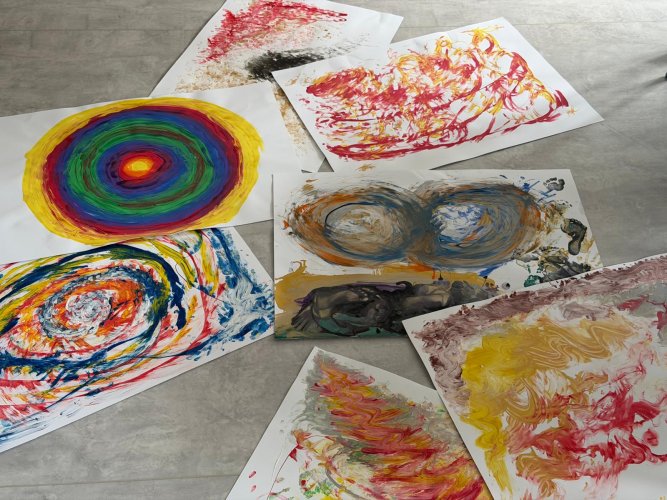
Playfulness – a forgotten strength in the adult world
In September, I facilitated two very different training sessions: one with instructors from the Youth Guard Centre (Jaunsardze), whose daily lives are structured and disciplined; the other with colleagues from the Latvian Children’s Support Foundation, whose work is, by its very nature, profound and emotional. On both occasions, something unexpected happened—I became a part of the very process I was facilitating.
When I first learned these methods as part of a project, the experience was deeply personal and therapeutic for me. I engaged with them, allowed myself to feel them, and understood them through my own lived experience. Yet, I did not anticipate that they would take on an even deeper significance when I began passing them on to others. I found myself present with these individuals during that intimate, fragile moment as they underwent the process themselves. It is a unique experience—to be the one creating a space for the inner experiences of others, while simultaneously feeling as though I, too, am within that very space.
I find it fascinating how the exact same method manifests differently in each group, transforming and adapting to what that specific group truly needs. In one setting, a simple sheet of paper with words and lines momentarily leveled the hierarchy that the instructors carry with them every day. In another, that same piece of paper opened up a conversation about the loneliness that often accompanies the helping professions. I facilitated it both times, and on each occasion, it felt almost like a different method—because the space we co-created was different.
At one point, while we were working with words and associations, I realized that I had lost the professional distance I usually maintain as a facilitator. The conversation became so profound that it momentarily unsettled me, as it took on a distinctly therapeutic quality. It struck me that this might be the very strength of these methods: they don’t ask for permission to go deeper—they simply go there, provided the space allows for it.
A thought occurred to me—one that feels more important than anything else: I am the platform through which these methods reveal themselves to the world. It is not the method itself that determines how deep people can go; rather, it is defined by how open, present, and secure I—and my colleagues—are in that given moment. There were even times when, while facilitating, I felt the process reaching a depth for which I, personally, may not have been fully prepared. And that is exactly what I am taking away from this: the need to be better prepared next time—not just in terms of the method, but in terms of myself as well.
I am truly grateful for the opportunity to learn new tools and to pass them on to others. I feel enriched. Creativity and playfulness are a forgotten power in the adult world—a power that transforms everyone involved.
Aiga Bernsone – Helmane, mentor and trainer
Aiga took part in a study visit organised by Radi Vidi Pats in Liepāja this summer, which brought together youth workers supporting young people with fewer opportunities from the Latvia, Czech Republic, Spain and Croatia.
Funded by the European Union. The opinions and views expressed reflect the author’s views only and do not necessarily reflect those of the European Union or the Agency for Mobility and EU Programmes. Neither the European Union nor the granting body can be held responsible for them.