From Branches to Fertile Soil: Young People Explore the Principles of Permaculture
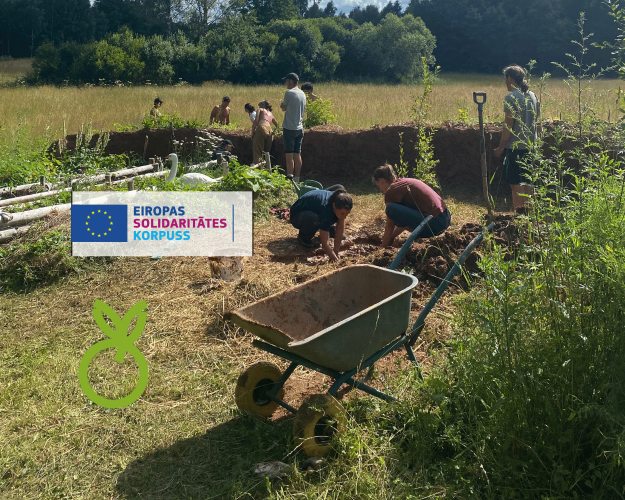
In July, young people from different European countries took part in the group volunteering project “Fruits and Campfires: Clay and Play” at the open farm “Zadiņi” in Smiltene Municipality, Latvia.
The young volunteers got involved in the farm’s daily activities and learned about sustainable farming and permaculture principles. They helped build raised garden beds using natural materials gathered from the surrounding environment. They collected branches, dug clay, gathered straw and raked hay. Each material had its own role in building the foundation of the beds and preparing the ground for future plant growth.
In permaculture, the goal is not to fight against nature, but to learn to work with it. This is also at the heart of this volunteering experience: cooperation.
Branches, leaves, straw and other plant-based materials, often considered garden waste, can become valuable resources for building healthy soil. As they gradually decompose, they form organic matter, improve soil structure and support the activity of soil organisms.
The young volunteers’ experience reminds us that sustainable farming begins with simple tasks, curiosity and a willingness to experiment. Sometimes, all it takes is looking at familiar natural materials differently to discover their potential to create something new and valuable.
The young volunteers encourage everyone to experiment and build their own raised garden bed using permaculture principles!
Autumn is a great time to collect fallen leaves and prepare branches and other natural materials for the next gardening season. By building a raised bed in several layers, you can make good use of materials already available, reduce the need to buy additional supplies and gradually create fertile soil.
How to build your own raised garden bed
1. Choose a location
Find a suitable spot, taking into account sunlight, water availability and what you plan to grow.
2. Collect branches for the base
Place larger branches and pieces of wood at the bottom of the bed. They help retain moisture and provide nutrients as they decompose.
3. Add straw
Straw helps cover the soil, reduce moisture loss and suppress weed growth.
4. Use hay and grass clippings
Choose hay without mature weed seeds and use materials that have not been contaminated with unwanted substances.
5. Make use of autumn leaves!
Use them as mulch or add them to the middle layer of the bed.
6. Cover the top of the bed with soil and compost
This creates a suitable environment for plants to take root, while the lower layers gradually decompose over time.
7. Let nature do its work
A raised bed prepared in autumn will settle over the winter as the materials begin to decompose. By spring, it will be ready for sowing and planting.
Good luck with your experiment!
If you’re also interested in volunteering abroad, explore the opportunities here: https://ej.uz/hg5h
What the volunteers say
Daryna:
“I learned a lot about sustainability and the causes of global warming. I did things I wouldn’t normally do in everyday life and took on new challenges — now I feel stronger. I learned how to manage my time so that there would still be room for rest and fun. I will never regret the hours of sleep I missed, because the moments spent together with everyone else were priceless.”
Carlo:
“Connecting with nature and adapting everyday life to ecological systems, such as composting toilets and reusing resources, gave me the confidence and skills to live in greater harmony with nature. Working on a permaculture garden for the following spring helped me develop patience, long-term thinking and a sense of responsibility for our community’s shared future.”
Annika:
“Living and working on an open farm helped me develop adaptability and teamwork skills. I reflected on my own boundaries and learned to cooperate within an international group. We prepared meals together for the volunteers, which helped me learn to take responsibility.”
Kristofers:
“Listening to stories about everyday life in other cultures gave me a completely new perspective on both the local surroundings and other places in Europe, Brazil and Tunisia.”
Read the full story and see more photos on our Facebook page and Instagram.
This volunteering activity was made possible by the European Union, which funds the European Solidarity Corps programme under which the Fruits and Campfires projects are carried out.
This publication reflects the views of the author only, and the European Commission cannot be held responsible for any use that may be made of the information contained herein.
